Answering The Top Small Business Health Insurance Questions

As a small business owner, providing health insurance to your employees can be confusing, overwhelming, and expensive. Here at Alignable, we want to make it easier for you to find the information and resources you need to make the decision that works best for your business.
So we asked thousands of small business owners to chime in with their most pressing health insurance questions and then brought them to an expert. This webinar breaks down the answers to those questions and more.
For a complete resource on all things health insurance, head over to our Health Insurance Guide for Small Business Owners.
Webinar Transcript
Geoff: Hello, everybody. Welcome to Alignable's webinar "Understanding Health Insurance."
My name is Geoff, I'm going to be your host today. I am the VP of Product here at Alignable, and, in addition to being a father, my background kind of formerly, I used to run a local real estate company, so I spent my career kind of started off running a small business. And then, transitioned to owning a social media marketing company that specialized in helping small businesses use Facebook, Twitter and LinkedIn. So I've really spent my entire life and career focusing on small business, it's something I'm really passionate about.
And so, about a year ago, when I joined Alignable, I was most excited about the ability to help small businesses at scale, right, we have four and a half million members, kind of learn the in and outs.
- How do we learn from each other?
- How do we help each other?
- How do we grow our businesses together?
Why is Health Insurance Important for Small Businesses?
This the first in what we hope to be kind of an ongoing series, where we get a chance to do that, by answering some questions that are out there. Some of you may have seen, a few months ago, we started running some polls specifically around health insurance, and whether our members had questions about it, whether they were offering it, they didn't, they wanted to, they thought they were paying too much, too little. (Not surprisingly, absolutely zero people think they're paying too little for health insurance.)
And so, what we realized, is we said, you know what, there's a ton of information out there. There's a ton of misinformation out there. And I think the best thing we could do for our members is find a way to get some real solid, clear answers.
And so, we started working with our partner, GoHealth, and said, "Hey, guys, would you mind kind of working with us, doing this little Q&A presentation to answer some of those really common questions we've heard from our members about health insurance?" And they very graciously said yes.
Related discussion: What is most important to you about health insurance?
And so, I am happy to introduce kind of my companion on the webinar today, Brad. And I'm gonna let him introduce himself, and tell you a little bit about his background and GoHealth as a company.
Brad: Thanks, Geoff. Yeah, my name is Brad Rocque. I'm actually getting married this May, and super-excited to start a family with my fiance. I've spent over 10 years in the benefits and HR fields. A majority of that working specifically with small and mid-size companies, that have 100 employees or less. I've been with GoHealth for about two years, and run our Group Division.
A little bit about GoHealth: We're the largest insurance brokerage in the country. And we're still experiencing tremendous growth of two to 400% a year. Our mission is really to empower our customers through education and choice. We were founded in 2001, and are headquartered in Chicago. We've got sales offices in Chicago, Charlotte, and Salt Lake City. We've got about 450 corporate employees. And during peak season have about 2200 licensed agents across the country. We're partnered and contracted with over 100 insurance carriers, and have hundreds of strategic partners, as well.
Geoff: Awesome, fantastic! And congratulations.
Brad: Thank you.
Geoff: On the wedding. That's very exciting news. Really, what we're gonna do, the way this is gonna go for everybody, is I'm gonna kinda take Brad through those top five questions that we heard from members. Just so you're not surprised, I did give him the questions in advance, so he could prepare some information. So he's not making these slides behind the scenes as we go. But, you'll notice over on the side you should have the, to the right, the ability to ask questions. I have got Phil, say hi, Phil.
Phil: Hi, everyone.
Geoff: So Phil works with me here on the Product Team at Alignable. He's monitoring these questions. If at any point you got a question, send it over. At the end, Phil's gonna kinda curate, put all the questions that are alike together, and he's gonna shoot 'em over our way. That's actually, usually, my favorite part of these webinars, is kind of get hearing directly from you guys what your questions were after the fact. Don't think 'cause we don't address it right away, we're gonna address 'em all that end, and it's gonna be fantastic.
The Top Five Questions That Small Businesses Ask About Health Insurance
With that said, let's go ahead and kind of get started with these questions.
Do Most Small Businesses Offer Health Insurance to Their Employees?
The very first question that we heard a lot: Where do I fall on the scope of businesses offering health insurance? Do employers usually offer group health insurance? Whether you do or you don't, a lot of our members didn't really, they didn't really know if they were kind of in the majority, the minority, were they ahead, behind? So, Brad, why don't you start off, kind of just give us a scope of the landscape of small businesses and offering health insurance.
Brad: You know, the short answer is, yes, most employers do offer some type of health insurance, and/or employee benefits. These benefits are consistently rated as the second most important thing behind their salary, in terms of recruitment and retention of employees.
According to the Affordable Care Act, or the ACA, as I'll refer to it throughout the presentation, employers with more than 50 full-time equivalent employees are required to offer health insurance, or face a penalty.
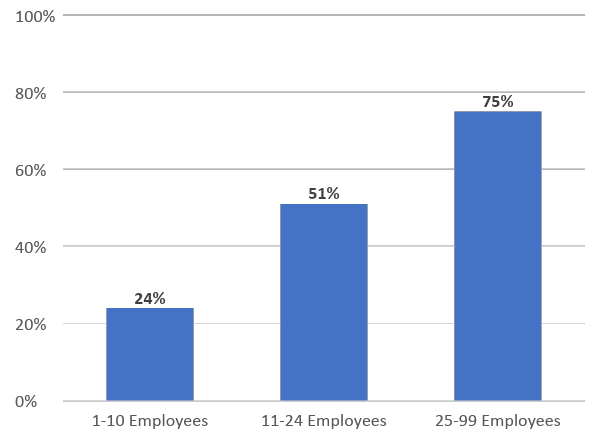
What Percentage of Small Businesses Provide Health Insurance?
In the most recent data:
- About 24% of employers with one to 10 employees offer health insurance
- 51% of employers with 11 to 24 employees
- 75% of employers with 25 to 99 employees offer health insurance
Geoff: Interesting, and yeah, you know, I know from much of my career kind of with employees, it's extremely expensive to replace an employee that leaves. So retention is so important to keep, you know, your team, keep the team together, the ones who understand your business, they're working with you, and avoid those costs, as kind of high turnover is deadly. Health insurance is really important, it sounds like, in that respect.
Brad: Definitely, and with unemployment as low as it is, it's hard to find good people. So when you do find 'em, you definitely want to keep 'em.
Related content: Health Insurance Basics for Small Business Owners
What are the Health Insurance Options for Small Business Owners?
Geoff: Excellent. All right, so, the next question that we hear is: What are the differences between small business health insurance options?
And I know this one I myself don't understand all these options, I'm really excited to see the kind of answers, because, I know there's a lot out there and it's certainly not simple anymore, if it ever was. Let's see what you can do, to kind of clear this up for us.
Brad: Yeah, of course. I'm gonna focus on the different types of major medical plans today. But, before we do that, I want to give a quick overview of how major medical plans work, so that we're all on the same page.
With major medical plans there is:
- A deductible that can range from zero dollars up to around $7,000 per year. And this is the amount that an employee would have to pay out-of-pocket before what's called the coinsurance kicks in.
- Coinsurance is the percentage of covered healthcare costs that the insurance company will cover after the employee has hit their deductible. Usually, that's around 20%, leaving the remaining 20% for the employee to cover.
- Copays are a set amount that the employee would pay for a given service, such as a doctor visit, a specialist visit, X-ray, lab tests, et cetera. Typically, the employee only has to pay for the copay for these services, even if they haven't hit their deductible. However, sometimes, copays are implemented after the deductible has been hit. So definitely pay attention to that when you're looking at your plan options.
- Out-of-pocket maximum: Once the employee has spent enough out of their own pocket, including their deductible, copay, and coinsurance payments, and they reach their out-of-pocket maximum for a year, the insurance company then covers 100% of the remaining charges for the rest of the year.
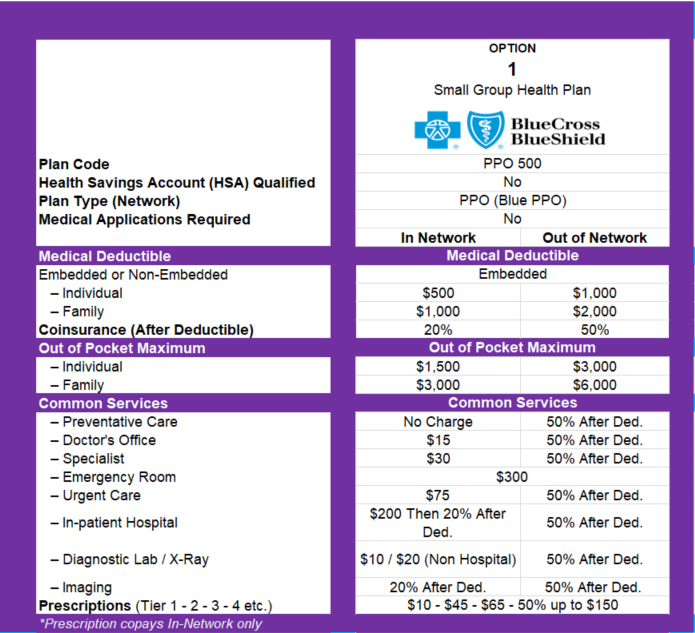
Additionally, under the Affordable Care Act, preventative care is always covered at 100%, regardless of whether you've hit your deductible, or not.
For small employers, for those less than 50 full-time equivalents, plans are typically age-rated. So that means that the rate is determined by the age and the location of your enrolled employees, and their dependents.
Many times, insurance companies will use those age rates to determine what's called composite rates, which is what we're more familiar with. So you have a set rate for an employee only, a set rate for an employee plus spouse, a set rate for employee plus children, and family coverage.
Usually, employers will get a choice of offering age versus composite rates. It varies by state and carrier. However, if you're a large group, or you're on a non-ACA plan, rates are underwritten instead of age-based. And those are always listed as composite rates.
Many of you might be familiar with these, but, we'll run through 'em quickly, just to make sure we're on the same page.
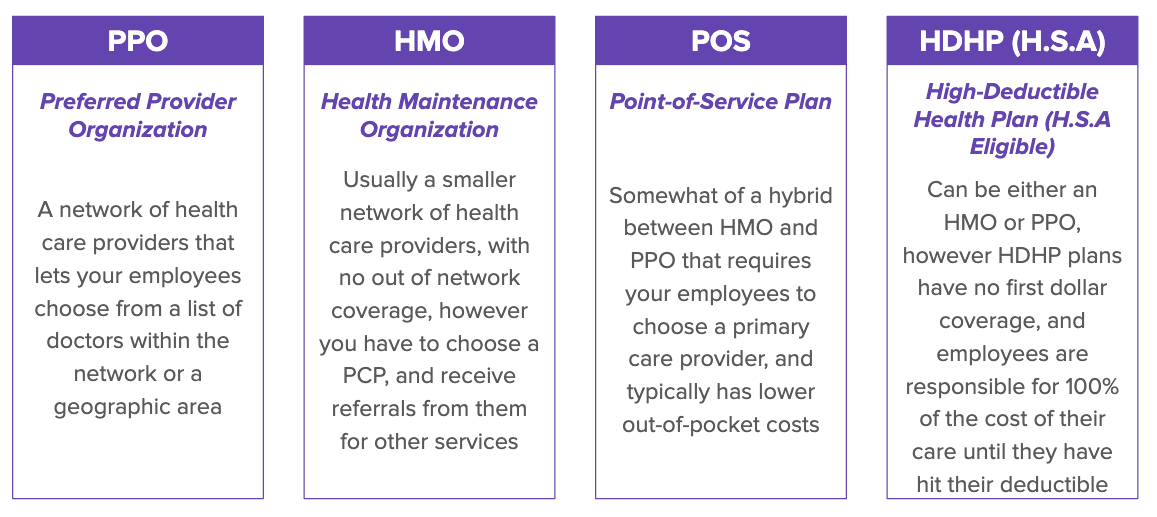
PPO
The first and most common type is what's called a Preferred Provider Organization, or a PPO. These tend to be the most expensive. But, they have a large network of health providers that are contracted with the insurance company, and are considered in-network.
So you're gonna receive the most benefits from the insurance company by staying in-network. You can see any doctor you want at any time. However, you will pay more if you go to an out-of-network provider.
HMO
The second is called a Health Maintenance Organization, or an HMO. Like PPO plans, these still have a network of contracted health providers. But, that network's usually much smaller, and oftentimes it's confined to a specific geographic region, such as a city, or a state, et cetera.
Unlike PPOs, with an HMO you need to designate a Primary Care Physician, or a PCP. And you must get a referral from that PCP to receive any additional services. So if you want to go see a specialist, or you need to get an X-ray, a test, or a procedure done, you have to see your PCP first. They'll provide you a referral, and then you can go get those services performed.
Additionally, with HMOS, there is no out-of-network coverage. So you have to go to those in-network doctors. And let's say you get cancer and want to go to a cancer specialist that's out-of-network, you won't get any coverage from your insurance company without that referral.
PPO/HMO
The next type of plan is very uncommon and rare, so you'll probably never run into it. But, just in case, it's basically a hybrid of a PPO, and a HMO. So you do have to designate a PCP, a Primary Care Physician, but, you don't need a referral for all services. So you can go to an in-network specialist without a referral.
HSA or HDHP
The last type if what's called a High-Deductible Health Plan, or an HSA Plan. And these plans can either be an HMO, or a PPO. However, these plans don't have any first dollar coverage. So that basically means that employees are responsible for 100% of the cost of their healthcare, until they've hit their deductible.
I'll give you a quick idea of how that works. So let's say you have to go see a doctor, and they charge $125 for that visit. On a typical PPO, that's not a high-deductible plan, you just pay your copay, which might be, let's say, $30. When you're on a high-deductible health plan, the doctor would charge $125, and since they're in-network, you would still get that network discount, which in this case is 45%. So the actual cost to you would be $68, instead of that $30 copay. And that would count towards your deductible.
HSA plans are also the only plans where you're allowed to participate in a Health Savings Account, or an HSA, which is an employee-owned account that allows employees to contribute money tax-free, to pay for qualified medical expenses.
The great thing about HSAs, is that the money is triple tax advantaged. So you don't pay taxes on money going in. You don't pay taxes on any interest earned. And you don't pay taxes on any money going out, as long as it's used for qualified medical expenses.
Because of this, these accounts can often be better than 401ks, in many cases, and used as a retirement vehicle, in addition to helping you pay for your medical expenses.
So an HDHP plan is paired with this HSA account, and that's what makes up these, you know, total HSA plans, or HDHP plans. Again, these are employee-owned, so employees get to keep them their whole life, regardless of if they change employers, insurance plans, retire, etc. Employers can also contribute towards their employees HSA accounts, if they wish. But, once that money is in the employee's account, it's that's employee's money forever.
Related content: HMO, PPO, HDHP + More: SMB Health Insurance Plans
Geoff: Interesting, so, essentially, just to make sure I got it right, with these high-deductible plans, you're probably gonna have to pay more out-of-pocket to start, but, you have this very tax exempt ... I think it's a sophisticated tax accounting term, right, very tax exempt account, where you can contribute to, to kind of help offset those added up-front costs.
Brad: Exactly, and these tend to be less expensive than, you know, your typical PPO plan for a similar plan design. So the thought is, you know, you save a little bit of money on your premiums, you put that towards the HSA account instead. And then you have the money available when you need to go use the insurance.
Geoff: Excellent, very cool.
Brad: In addition to HSAs, there's two other kinda funding vehicles that we'll talk about quickly, as well.

FSA
The second is what's called an FSA, or Flexible Spending Account. And it's very similar to an HSA, except that it's owned by the employer. And if you don't use all the money in your account in a given year, you're gonna lose the rest of it.
So these are best for employees who are not on an HSA-eligible plan, that want to put some tax-free money aside. But, they know what their expected healthcare expenses will be throughout the year.
So, for example, you have a chronic condition like diabetes, or you're on a specialty medication that's expensive, and the copay is $100 a month. So you would use an FSA to put away $100 a month to pay that copay tax-free. And that way you know that all your healthcare expenses are covered with those pre-tax dollars throughout the year. But, you don't want to have leftover at the end of the year, if that makes sense.
Geoff: Absolutely.
HRA
Brad: Finally, there's what's called an HRA, or Health Reimbursement Account. And this is another type of account that is owned by the employer, that's really setup to reimburse employees for deductible expenses.
So, for example, a company might offer a plan with a $3,000 deductible, and they put an HRA in place to reimburse the employees for the last $1,000 of that deductible. This allows them to offer a less expensive higher-deductible plan. But, to the employee, it really feels like a $2,000 deductible plan, rather than a $3,000 deductible plan.
Geoff: Excellent. And I just, Phil just gave me the hand sign, he's got a few, I know we said we'd wait 'til the end with questions, but, apparently, the, the members are asking some really good ones. So I think he wanted to jump in and ask a question or two that would be particularly appropriate.
Phil: Yeah, Gary just chimed in on HSAs, and he was asking if HSAs have a maximum, a minimum contribution, or a maximum contributions?
Brad: So minimums, again, it depends on the vendor that you use, and your employer, they can set minimums. You know, typically, it isn't worth the cost to setup an HSA if you're only gonna contribute, you know, $5 a month.
So most of time we'll see 250 as an average minimum per year. That being said, the maximum you can put in per year varies year over year, and it increases with inflation. For 2020, an individual can contribute $3,550. And if you have a family coverage, you can contribute up to $7,100 per year.
Phil: Yeah, and actually one other one, just in regards to HDHPs. What is the average amount of the deductible on HDHP? Who sets that amount?
Brad: So it depends on the plan that is chosen. So they've got the minimum to be eligible for an HDHP, I believe, is 1,500 this year. But it can go all the way up to, you know, 7,000. So there's a lot of different options in between there. And, obviously, the cost will be more expensive, or the premiums will be more expensive with a lower deductible plan.
Related content: Dental, Vision, and Spending Accounts: Benefits Beyond Health Insurance
What is the Average Cost of Health Insurance for Small Businesses?
Geoff: Awesome, all right, great. Keep those questions coming, everybody, these are fantastic. So, it leads to the third question, which is kind of very appropriate. So, all right, we have all these plans, all these options. How much does health insurance cost for small business owners?
Brad: So that's a little bit of a loaded question, because, it can vary greatly, depending on the type of plan that you're offering, as well as your location.
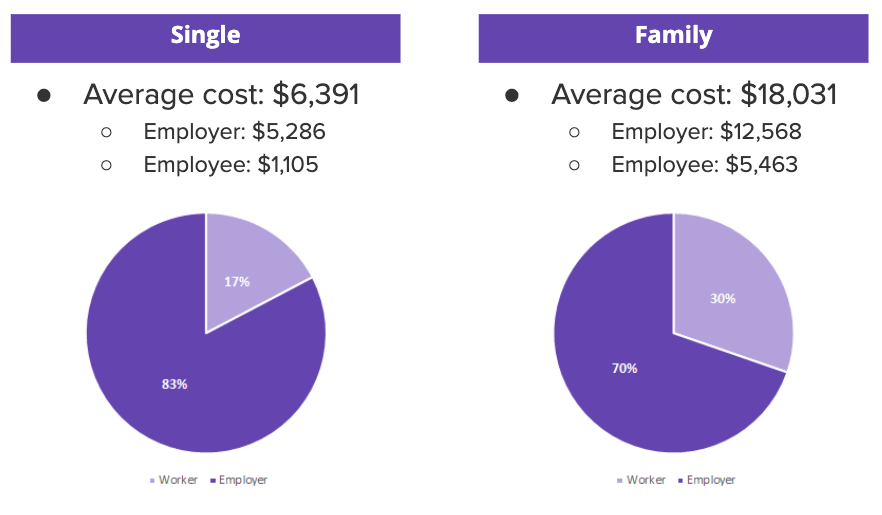
However, on average, across the country, in the most recent data:
- Single employee cost: the cost for a single employee is about $6,300 a year, or about $525 a month.
- Full-family coverage cost: And for a full family coverage, is about $18,000 a year, or about $1,500 a month.
- Employer cost: Employers, on average, are contributing about 80% of the cost, towards about 80% of the cost for insurance for employees, and about 70% for families. But, again, it varies by industry, location, et cetera. Employers can also choose to contribute more or less. So, again, these are just the averages.
Related content: The Costs and Benefits of Small Business Health Insurance
Geoff: Excellent, yeah, I know you and I talked about briefly beforehand that there are even options, if employers don't want to, or can't afford to contribute at all. That doesn't necessarily completely exclude them from offering the health insurance to their employees.
Brad: Exactly. So there are some carriers that don't have contribution requirements for employers. As well as, there's the one-time a year, at the end of the year, if you're looking for January 1st coverage, where fully-insured plans have to waive all contribution and participation requirements. If you're worried about not meeting participation, or don't want to, or can't contribute that 50% that most carriers ask for, that's a great time of year to look for benefits.
Related content: Rolling Out Your Health Insurance Plan to Your Employees
Can My Company Qualify for Programs Outside of ACA?
Geoff: And so, this next question we hear, you know, there's a lot of talk around ACA, also known as Obamacare, kind of like what are the programs outside of ACA or Obamacare that could offer a savings, right?
You know, small businesses, every penny matters, so, they want to do what's right by their team, by their employees, by themselves, ideally. But, kinda, you know, what's the, what's the most affordable way to do it?
Related discussion: How do health insurance costs impact your hiring decisions?
Brad: So that's a great question, and by far my favorite question of the day. So I'm gonna take a little bit of time here. And I want to introduce you guys to something that's called a level-funded plan.
What Are Level-Funded Plans?
These plans are specifically designed for small groups to act, look, and feel exactly like a fully-insured ACA plan, with all the same benefits, such as a level or set premium per month. And then, no risk of owing additional money throughout the year. And a large insurance company administering the benefits and dealing with the claims.
These level-funded plans are designed for small groups. They're fairly newer to the marketplace, came around, you know, in the last 10-15 years, and are becoming more and more popular as a way to get out of those ACA plans that are age-rated and can be expensive.
To qualify for level-funded plans, there is medical underwriting required, unlike traditionally fully-insured ACA plans, which are age-rated. When you're age-rated, your costs are based specifically on the ages of the employees that are enrolling. That assumes that the older that you are, the less healthy that you are, and the more claims that you're gonna have, which isn't always the case.
With level-funded plans, because, it's underwritten, it's based off the actual health of your employees, which can result in savings of 30% or more over a similar ACA plan, the average to healthy group.
How Do Level-Funded Plans Work?
Well, with a fully-insured plan, you pay your premium every month, and the insurance company keeps that premium, regardless of how many claims you have or don't have in a year.
So, for example, if they expect your group to have $100,000 in claims throughout the year, and you only end up having $50,000 in claims, the insurance company just made $50,000 in additional profits on a fully insured plan.
Conversely, if you had $200,000 in claims that year, the insurance company would pay all those claims, and the group wouldn't owe any additional money at the end of the year, or be subject to increased rates, because of their claims.
With level-funding, it works a little differently. On the back-end, your premium is broken up into three different buckets.
- Administrative: The first goes to pay for the administrative expenses for the insurance carrier to have you as a client. So think of things like ID cards, portals, claims processing, customer service agents, et cetera.
- Expected claims: The second bucket goes to pay for your expected claims. Because it goes through underwriting, they know the health of your group, and how much claims you should incur throughout the year, so they put that money aside to pay you for those claims.
- Stop-loss insurance: The last bucket, or the third bucket, is stop-loss insurance. And this covers your company, should you go over that expected claims amount.
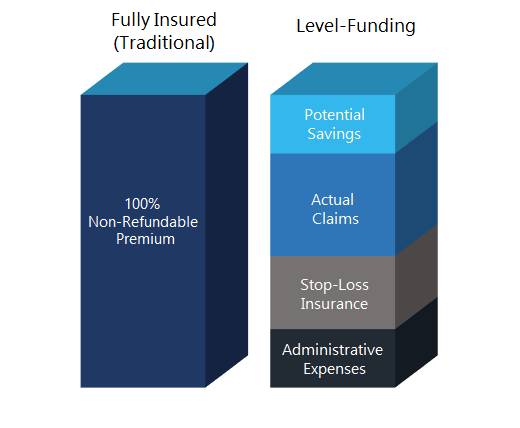
So using the same example as before, if you had expected claims of $100,000, and you only had $50,000 in claims throughout the year, you would be refunded some or all of that money at the end of the year, depending on your contract. And your premiums would most likely go down for the next year, because, your claims were overestimated to begin with.
Now, if you had $200,000 in claims, that stop-loss insurance would cover the extra $100,000 you went over, so you wouldn't owe any additional money.
However, you would probably see a large premium increase in the next year. Or you might even be denied your renewal. Which is okay, because, even though, you know, the rates went up, if the fully-insured ACA rates are less than what your new rates are, you can simply move back to a fully-insured plan. And you're able to enjoy those reduced premiums for that one year.
The final piece of level-funding that really makes it a nice program, is that you have access to your claims data. At the end of the year, we can look at all your claims that occurred, and, for example, we notice that 40% of the claims were out-of-network.
Well, we can train employees on the importance of using in-network providers, and how to find those providers, which will reduce your claims cost, and then, ultimately, reduce your premium cost. So it's really the only way that employers can take control of their healthcare costs. And see some savings over the traditional age-rated, fully-insured plans.
Geoff: That's fascinating, I hadn't heard of level-funded before, but, it seems like, for the most part, there's only upside. You've got potential money to save, and you're kind of covered if things go out of control.
Brad: Exactly. So I highly recommend everybody take a look at these plans. You know, maybe you evaluate 'em every year, or every other year. You might not qualify in one year. And then, you know, if there's a change in your employee makeup, and the next year you do qualify. Don't get discouraged if it doesn't make sense financially the first time you look at it, or you don't qualify. But, it's definitely something to shoot for, as you're thinking about your long-term healthcare strategy.
Geoff: Fascinating, and now, these kind of level-funded, do they apply to a specific type of health insurance plan, HMO, PPO, or are they across the board?
Brad: They are typically PPOs, but, they are across the board, as well. Again, working with a knowledgeable broker, they can kind of walk you through all the different options, and there's tons of different carriers, and they all work a little differently. But, it's the general idea of how it works that makes 'em intriguing.
Related content: How to Buy Health Insurance for Your SMB
How Can I Find out Specifically What Health Insurance Options Are Available to my Small Business?
Geoff: Excellent, well, I think that actually leads into our last question pretty nicely, which is, you know, I know from my past experience, I understand the different options that are available. And if I were to talk to someone, with all the acronyms and what not, I think I wouldn't be completely lost.
But, it also does sound like there's an incredible amount of variability in cost, and options that are available, based on, you know, a business. And it's not just the size, the number of employees, it's the location, the age and health of your employees play a role in the cost.
One of the other big questions we get all the time is, how can businesses specifically find out what the options are for them. You know, you could Google 'til your fingers fall off. But, you're not gonna really get an answer about you specifically.
And so, this is a question that actually we kind of asked GoHealth to help with. Because, we know that it takes, you know, really looking at an age-specific situation to get you an answer. What we kind of asked Brad and his team to do is, would they do custom, you know, referrals, or interviews, rather, with our members who wanted to know what their options were, and kind of walk them through. And they said, yes, which was fantastic!
What's gonna happen in a second, is Phil over here is gonna pop-up a little thing on top of the screen. So if you're sitting here saying, this is interesting, maybe I have options, maybe I can save some money, I think it just went, or it's about to go, there we go, you can actually claim these consultations that we asked GoHealth to offer to our members. And they will just talk to you, look at your details, and tell you exactly what your health insurance options are.
I think it's a really great opportunity for people to kind of wade through, and see where they stand in light of things. And I think we're gonna shortly thereafter, after now, we're gonna go through some of the other questions that you guys have been asking, and we're gonna pop this up again at the end. But, click the button, and just have a quick conversation, it certainly can't hurt, and they've been a, they've been nice enough to offer it. So, thank you, Brad, for doing that for our members.
Brad: Of course, we're more than happy to help. Even if you just have questions, or want some education, get in contact with us, and we'll be glad to assist you.
Geoff: Very cool, all right, so while people maybe plug-in their information there, I am going to see, put the mic back over to Phil, and see what he's got, see if he can stump Brad, come up with any questions he doesn't know the answer to.
Small Business Health Insurance Q&A
What is the Best Health Insurance Option for a Small Business with Two Employees?
Phil: So I saw a question early on. We are in a situation where my spouse also works for the company, we are a company of only two people. How does that work for groups versus individual options?
Brad: Again, if you have, if you're the owner and your spouse is your only employee, most insurance companies will not consider that a group, so you would not be eligible for group insurance.
That being said, if you had one other employee that was not related to you, you would then qualify for a group, and you could either enroll in a employee plus spouse coverage, or each of you could enroll as employee only coverage. If group is not an option for you, then you can always look at individual plans. Those are available through the marketplace, or through a broker that handles individual health insurance.
Geoff: And I'll kinda follow on there, you know, how... Let's say that we had just done this, this presentation all about individual coverage.
- Are the options crazy different?
- Are they pretty much the same?
- You know, what are the biggest differences, if you are looking at it from an individual perspective?
Brad: Yeah, so, I am not an individual expert. But, individual health plans tend to have much smaller networks. And the cost tends to be higher for individual coverage, than it is for group coverage, because, you're not really pooling the risk as much as you are with a group.
So there are still some options available. There's probably, you know, in a state, in Illinois, where I am, the individual options are probably about 25% of what the group options are. And there's much more limitations around carriers that offer individual coverage. So I think there's three in Illinois that offer individual, but, there is eight or nine that offer group coverage.
Geoff: Excellent, thanks.
Why Does Health Insurance Have Limited Open Enrollment?
Phil: Gary Simpson asked: Why is it that health insurance has limited enrollment periods each year?
Brad: That is a great question. I'm gonna speculate here, so don't quote me on this. But, they want to make sure that people are enrolling, not just because they have to. So if they allowed you to enroll any time throughout the year, you would wait until, you know, you weren't feeling well to go get healthcare.
You'd get the care that you needed, then you'd drop your insurance. Which, obviously, would cause premiums to skyrocket, 'cause they wouldn't be making any money off that. So by offering one time a year for employees to enroll, and again, this is for individual, it ensures that they're getting a good mix of healthy people, and people who are having high claims.
Geoff: Oh, interesting, I wouldn't have thought of that, but, that makes a lotta sense.
Is Direct Primary Care Combined With HDHP a Good Health Insurance Option for Small Business Owners?
Phil: Dan Schaeffer asked: Can you comment on the increasingly more common use of direct primary care membership, in combination with a HDHP?
Brad: I'd probably need a little bit more information on that question. But, if you're talking about a direct primary care, I do know that there are some doctors, and doctors practices now that are offering almost what's called like a membership.
So, basically, you would say, hey, I'm gonna pay, you know, $50 or $100 a month to this doctor that I've chosen, even though I'm on a PPO. And then, that particular provider will provide even more discounted rates, above and beyond what the insurance has negotiated with them.
And it's a way for them to increase their patient base, and have money coming even if you're not sick and going to see them. But, it also helps the employees, because, when they do go to the doctor, they're spending less money out-of-pocket on things like doctors visits, test, et cetera.
Geoff: Interesting, and is there any, is there anything that kinda precludes the people from doing, you know, entering into those arrangements based on health insurance? Are the insurance carriers happy to let that happen?
Brad: Really, it has nothing to do with the insurance carriers. It's all about, you know, the provider and what they choose they do. I haven't seen a ton of these, but, I'm hearing more and more about 'em. And I've heard some places are having pretty good success with 'em. I think only time will tell, to see how well these types of arrangements will work.
Geoff: Yeah, I know that, actually, we are, Alignable is headquartered in Boston. I actually saw, not too long ago, there was a virtual example of this, where you could, you know, you paid to be a membership with this doctor's office, and that membership meant that they would kind of diagnose you through text message, and sending photos of whatever that gross thing on your foot is. Which, you know, you don't want to go wait and sit in a waiting room, it has its benefits.
Brad: Exactly, and, again, a lot of times, if you don't have insurance, that's an excellent option, because, you can still get some discounted rates and things of that nature. If you are on an insurance plan, most carriers nowadays do offer telehealth or telemedicine, where you can, you know, call in and get diagnosed, and get a prescription over the phone, as well.
Geoff: Excellent.
What About Local Small Business Health Insurance Providers?
Phil: Mike Couture asked: How important is it to work with insurance companies in the state your business is located in?
Brad: Really, it... Again, I'm gonna go with, it depends. There's plenty of large national carriers, regardless, of where your business is. Or if you have multiple locations across the country, you can offer plans that'll work for everybody, regardless, of where they live.
But, there's also a lot of smaller regional carriers. Like, for example, California has Kaiser. That's extremely popular out there, and the cost compared to some of the national carriers is much less. Missouri has a Cox HealthPlan, where there's a system of hospitals near Springfield, Cox Health, that offers their own health plan. So you can get a lot less expensive healthcare through some of the smaller regional carriers.
But, the issue becomes, hey, you're on vacation in New York, and something happens. Well, there's nobody in network in New York. Again, working with a broker, to understand your needs, and what you want to make sure is covered, or not covered. They can help guide you to, you know, whether a regional carrier would make sense, or if a larger national player is a better fit for ya.
Geoff: Awesome, and that actually kind of reminds me like if you switch to the next slide, one of the things that we had asked you to prepare a little bit, is just in case we have any other kind of insurance, or benefits, you know, industry members on the phone, you know, we have many, many of them are a part of Alignable, one of the reasons we like GoHealth, is that you partner a lot with other companies, and other insurance brokers, and in this industry.
Just really quickly, touch on that for anyone here, because, that kind of points to that local angle.
Brad: Yeah. So I haven't mentioned before, you know, we've got over 100 strategic partnerships, and we partner with a wide range of companies, including, you know, the small, local brokers who don't have access to some of the carriers, or states that some of their clients might need. We also partner with a lot of larger brokers that don't want to deal with small businesses.
We do a lot of work with payroll and HR companies, where they'll help companies, you know, obviously, with their HR, outsource the HR, and then utilize us as the benefit broker. We partner with property and casualty brokers, who will handle the business insurance, while we do the employee benefits. And then PEOs, accountants, 401k providers. Obviously, insurance carriers. Anybody who really, you know, works directly with small businesses, and, you know, where we can refer business back to them, and they can refer business to us, we're very happy to partner with.
So if you guys have any questions on that, or want to discuss a potential partnership, definitely, don't hesitate to reach out.
Geoff: Awesome, yeah, and, you know, Alignable is all about referrals. We love that, right?
Brad: Exactly.
Geoff: We love that, you know, bringing kinda big number benefits to the little guys is kind of what we're about, and I think what GoHealth is about, so that's fantastic.
What About Health Share Plans Like Medi-Share?
Phil: This question just came in. Can you comment on Medi-Share type plans?
Brad: Medi-Share, again, not 100% sure what you're referring to. I think it's more of a Medigap. And, typically, that's insurance that will cover the things that Medicare does not. Again, you'll pay a premium, and it basically lies on top of the Medicare insurance that you have, to limit the out-of-pocket expenses that you'll have throughout the year.
Those are typically offered more on an individual basis, versus a group basis. Again, GoHealth specializes in individual, and got a whole team of people that all they do is work with these Medigap or Medi-Share policies. So you just need to find a good broker that can kind of walk you through your different options, and what you need, based on your current health situation.
Geoff: Excellent.
Related discussion: Are health share plans legit?
How Frequently Should I Be Reviewing My Health Insurance Benefits?
Phil: How often should I be evaluating options when it comes to employee benefits?
Brad: We recommend at least once a year at your renewal time, doing a full analysis of what's available. Every broker works a little bit differently, and will say something different. But, there are changes every year to not only rates, but, plan options, plan designs. So if you're not taking a look at it, you could miss out on, you know, huge potential savings.
You know, for example, I had a client in, it was North Carolina last year. They were with Blue Cross, and they got like a 10% increase. We shopped the marketplace, and moved 'em to a similar carrier, and were able to save on the, virtually, the exact same plan, save them about 15%.
So if we hadn't done that analysis, we wouldn't have found that. So I would say, definitely, at least once a year, at your renewal time. Or, if there's a major change in your employee demographics throughout the year, so you acquire a company, or you double in size, it might not hurt to do it mid-year, as well.
Geoff: Excellent.
Related discussion: How often do you review your health insurance coverage and options?
Does Your Company, GoHealth, Partner With Supplemental Insurance, such as Aflac?
Brad: Actually, we do. And Aflac is one of our partners. But, we've got several different insurance carriers that do work site benefits, which are things like, you know, critical illness, supplemental insurance, etc. So, again, depending on, you know, your employees, and your company's needs, we can help guide you to the carrier that might be the best fit for ya, at the best cost.
How Much Time Does It Take to Roll Out Health Insurance to Your Employees?
Geoff: Excellent. And my, I think, that got most of the questions, and we're coming up on the time. But, I had one last one, kind of just talk a little bit about how long the process takes. Some of our members listening, maybe they're expecting to start hiring in the future. Maybe, well, I think we all hope to be hiring in the future, right?
How long does it take to kind of go from start to finish, looking at your options before you're really ready to offer health insurance to your employees?
Brad: So, really, we can go as quickly as anybody, as you can go. If you reach out to us today, and say, hey, I want to get moving as quickly as possible, we can get a quote and proposal in your hand, usually, within two the three days.
From there, you know, we have to setup the plans, and that can take anywhere from, you know, a week or two, to three or four weeks, depending on the carrier, and how long it takes them to implement things once open enrollment is complete, and we've submitted all the paperwork.
So I would say, you know, rule of thumb, plan on about a month. But, in certain situations, we've gotten things done in a week to a week and half before, as well.
Geoff: Excellent. Well, I, again, Brad, I can't thank you and GoHealth enough. This has been fantastic, fantastic, I learned a lot that I had absolutely no idea about. And, hopefully, it was really valuable for the members. Again, Phil is throwing up the little pop-up, so, if you want to get that consultation with someone at GoHealth, you can do so. And, yeah, Brad, you know, any last words? We really appreciate it, and thank you here from Alignable.
Brad: No, thank you, guys, very much. It was a pleasure speaking with you today. I hope you all learned something. And, again, don't hesitate to reach out, if you guys have questions, or want to talk further.
Geoff: Absolutely, all right, everybody. Have a fantastic rest of your week, have a great weekend, and we wish you success here from Alignable. Take it easy.
Get answers to all of your health insurance questions in our 2020 Health Insurance Guide for Small Business Owners.
What did you learn about health insurance in our webinar? What's still on your mind? Tell us below!