Lipedema Treatment
Lipedema
Lipedema is a commonly misdiagnosed fat disorder usually found in women. Lipedema most often affects the legs, but can also be found on the arms.
Lipedema is a progressive disorder that can be helped through the use of Electro-Lymphatic Therapy (ELT) and Manual Lymphatic Drainage (MLD) along with compression.
Lipedema is suspected to be genetic and is often triggered by hormonal changes that happen at puberty and menopause/peri-menopause. Traumatic events such as surgery, especially related to reproductive organs are also suspected as triggers of the disease.
Stages of Lipedema
Early tell-tale signs of Lipedema are the development of a cuff around the ankle where the fat distribution stops (the foot is usually normal size), extreme sensitivity, pain, swelling, and easy bruising.
In later stages, the leg typically develops a column-like shape and the skin begins to pucker.
As the disease progresses, the skin begins to develop hanging folds, and in the final stages the fat distribution can become severe enough to greatly impede mobility.
In the final stages, the fat and fascia can impede the flow of lymph by constricting the lymphatic vessels. When this happens, a secondary condition known as Lymphedema develops. When a person has both Lipedema and Lymphedema, the condition is then called Lipo-Lymphedema.

Stage 1 Lipedema
Stage 1 of Lipedema looks like normal legs. They may appear to be a bit puffy and have a distinctive marshmallow-like feeling when touched. Stage 1 “Lippy Legs” (as they are referred to by women with the condition) may appear to have swelling – as if someone has been standing all day long.
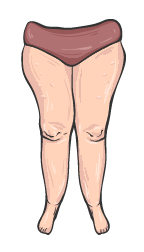
Stage 2 Lipedema
Stage 2 “Lippy Legs” also have the marshmallow-like feel to them, but they take on a few new characteristics.
Numbers 2 & 3 are evident, but not readily apparent in Stage 1.
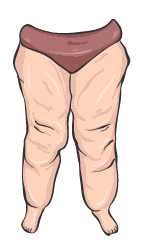
Stage 3 Lipedema
In Stage 3, Lipedema goes from looking like someone who has “big legs” to a more disfiguring appearance. The following changes are apparent in Stage 3:
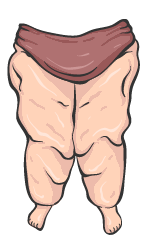
Stage 4 Lipedema
Stage 4 Lipedema becomes severely compromising to health. In addition to the mobility challenges that the large deposits of fat cause, other systems of the body become affected.
When legs reach Stage 4, the lymphatic system is compromised which causes a perpetual backup of fluid. Over time this develops into Lymphedema. The condition is then often referred to as “Lipo-Lymphedema.”
Symptoms in Stage 4 include weeping of fluid from the legs, extreme swelling, and the development of abnormal growths.
Treatment for Lipedema
Lipedema is greatly aided by lymphatic drainage. Both Electro-Lymphatic Therapy (ELT) and Manual Lymphatic Drainage (MLD) are effective in treating Lipedema symptoms. However, the disease is progressive and often does require specialized liposuction for reduction of the leg size. The type of liposuction used is referred to as lymph-sparing liposuction because it uses very small tools that do minimal damage so as not to further impair the lymphatic system.
Lipedema fat is exercise resistant and will not reduce even under the most strenuous exercise programs. Exercise is recommended, however, as it does help to keep the body’s normal fat at normal levels. While this may seem unimportant, there seems to be a link to obesity and the more severe cases of lipedema. Women who are not obese typically have an easier time keeping the lipedema from progressing as rapidly.
The only diet known to reduce Lipedema fat is the ketogenic diet. It does not come without its own risks, however. You should speak with a knowledgeable physician and dietician to determine if this diet is safe for you.